
Authenticity
When the System Gets Your Name Wrong
I do love a typo!
What’s in a Name?
Recently I discovered that a photograph from my ballroom dancing days with Sonia Kruger had found its way into the Getty Images archive.
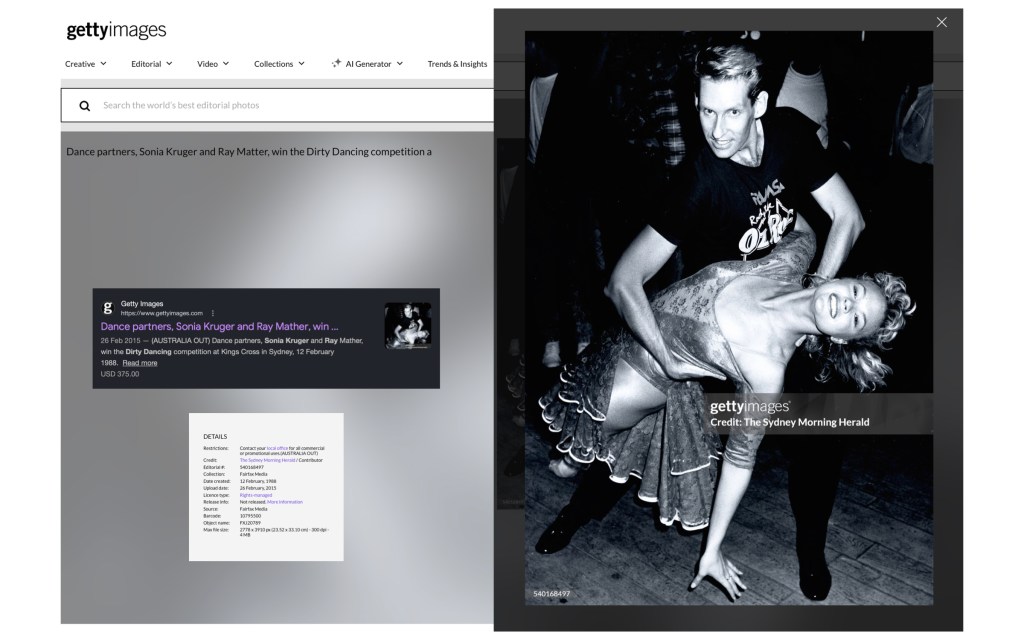
The image survives.
The memory survives.
The story survives.
My name, however, did not.
According to Getty Images, I am not Raymond Mather.
I am Ray Matter.
I have emailed Getty Images twice requesting a correction. During the preparation of this article, the record itself appeared to change from “Ray Matter” to “Ray Mather”. Yet traces of the earlier version continued to appear across search engines and AI-generated results.
Which made me smile.
Because somewhere in the digital archives of Australian dance history, a parallel version of me continues to dance his way across the internet.
His name is Ray Matter.
And apparently he was rather good on a dance floor.
At first glance, this might seem like a trivial mistake. A typo. A misplaced letter. An administrative oversight from decades ago.
Yet the longer I sat with it, the more interesting it became.
Because Ray Matter is not an AI hallucination.
He is not a software bug.
He is not a failure of technology.
He is the product of a very human mistake that has now been faithfully preserved, copied, indexed, and redistributed by digital systems.
In a strange way, Ray Matter tells us something important about archives, memory, and the age of artificial intelligence.
Between 1986 and 1988, Sonia Kruger and I danced professionally together during a period when ballroom dancing enjoyed a vibrant public profile throughout Australia.
For three years our lives revolved around training, competition, performance, travel, and the pursuit of excellence that serious ballroom dancing demanded.
We trained at Studio 112 in Oxford Street, Sydney, under some of Australia’s leading dance professionals and competed extensively throughout Australia and the South Pacific. During that time we became the 1987 South Pacific DanceSport Championship Professional New Vogue Champions and Australasian Champions.
One of the highlights was representing Australian ballroom dance at the Australian Bicentenary celebrations in Hong Kong, performing for the Australian Consul General.
Another memorable chapter arrived with the extraordinary popularity of Dirty Dancing.
Sonia and I entered and won a major Dirty Dancing competition held at Oz Rock Cafe and Hartz Nightclub in Kings Cross, Sydney, owned by Phil Harte The event was judged by Richard Wilkins and Olivia Newton-John.
The win generated considerable media attention and opened doors beyond the competitive dance world.
Shortly afterwards, Sonia and I were engaged to perform and model as part of the 1988 Louis Féraud National Tour. The company directors were Maria Findlay and Lady Sonia McMahon, and the tour brought together fashion, performance, media, and high-profile social events across Australia.
One of the most memorable engagements was held at the newly opened Grand Hyatt Melbourne on Collins Street. Organised by Melbourne social identity Lilian Frank, the event attracted guests paying $1,000 per person.
It was from this period that the now-famous Getty photograph emerged.
The image survived.
Sonia’s name survived.
Mine somehow became Ray Matter.
By 1990, our professional partnership had largely moved in different directions.
Earlier that year, Sonia and I appeared together in Wallflowering, a State Theatre Company of Tasmania production staged at the Peacock Theatre in Salamanca, Hobart. The work incorporated ballroom dance within a theatrical setting and remains an important chapter in my creative archive.
After returning to Sydney, we regrouped specifically for ABC Television’s That’s Dancin’, one of Australia’s pioneering televised dance competitions.
We had not competed professionally together since 1988.
Yet the partnership quickly found its rhythm again.
We became finalists and ultimately placed third.
Around the same period, we also appeared together as a dance couple on the ABC television series 3 Men and a Baby Grand.
Like many creative partnerships, our paths eventually diverged once more.
Not long afterwards, my own journey led into the world of Strictly Ballroom. Sonia followed her own successful path through television and media.
I followed mine through choreography, theatre, photography, visual arts, curation, and eventually the creation of ART1 and ACXN.
What happened next is what makes this story interesting.
The typo did not stay in Getty.
It travelled.
Getty preserved it.
Google indexed it.
Search engines displayed it.
AI systems inherited it.
As I began investigating, I watched the error propagate through multiple layers of the modern information ecosystem.
Yet something unexpected also occurred.
The systems increasingly understood the broader story.
Google correctly associated
Sonia Kruger and me as dance partners.
It connected Dirty Dancing.
It connected That’s Dancin’.
It connected Strictly Ballroom.
It connected ballroom dancing, television, archives, and historical records.
The system understood the story.
It just didn’t yet fully understand the name.
That observation stayed with me.
Because it highlights the difference between what might be called entity truth and metadata truth.
The entity truth is that Raymond Mather danced with Sonia Kruger.
The metadata truth says Ray Matter danced with Sonia Kruger.
The system is simultaneously right and wrong.
And that is a fascinating place to find ourselves in 2026.
For many years we assumed that archives represented objective truth.
But archives are created by people.
People make mistakes.
A photographer takes the picture.
An editor writes the caption.
A clerk enters the metadata.
A database stores the information.
Years later a search engine indexes it.
An AI system reads it.
And suddenly a typo made decades ago begins travelling through the digital world as fact.
That is the lesson of Ray Matter.
AI did not create Ray Matter.
A human did.
The technology simply inherited the error.
The discussion about AI accuracy often misses this point. Data is only ever as reliable as the information entered at the source. If the source contains an error, the error can be amplified across archives, search engines, databases, and AI systems.
Every archive contains two histories:
The history of what happened.
And the history of what was recorded.
Most of the time they are the same.
Occasionally they drift apart.
Perhaps that is one reason I have spent so much time building archives of my own work.
Not to preserve achievements.
Not to create a monument.
But to preserve context.
To connect people, places, events, and stories before they become disconnected fragments.
The irony is that the correction already exists.
Across my own records, programs, photographs, journals, and archive stories, the evidence is there. Studio 112. Wallflowering. That’s Dancin’. 3 Men and a Baby Grand. Strictly Ballroom. The timeline remains intact.
Yet the typo continues to travel because errors often propagate more easily than corrections.
During the preparation of this article, the Getty record itself appeared to change from “Ray Matter” to “Ray Mather”. Yet Google continued to display the earlier version. The correction had been made, but the correction had not yet fully travelled through the system. Watching that happen in real time became part of the story itself.
If there is one lesson in all of this, it is that authenticity requires participation.
Stories do not preserve themselves.
Archives do not correct themselves.
History does not always tell itself accurately.
Sometimes we have to step forward and add our own voice to the record.
The Getty photograph got my name wrong.
The memories did not.
Somewhere in the digital world, Ray Matter is still dancing with Sonia Kruger.
I wish him well.
As for Raymond Mather, the journey continues.
And perhaps between the two of us, the story is finally complete.
Supporting Archive Material
For readers interested in the broader history behind this story, related archive material can be found within the ART1 Archive, including Studio 112, Wallflowering, That’s Dancin’, 3 Men and a Baby Grand, and Strictly Ballroom.
Full collection of images Raymond Mather and Sonia Kruger photographed by Bob Barker for the Daily Mirror at Studio 112, Darlinghurst, 1988.
Together they form part of an ongoing effort to preserve the context, connections, and creative histories that sit behind the public record.

